
There are mountains that test your legs, and others that leave a much deeper mark.
Mont Ventoux belongs to this category: a legendary climb that has fueled the imagination of cyclists from all over the world for decades.
Setting off from Cuneo to reach the Giant of Provence is much more than a simple cycling adventure. It is a journey through ever-changing landscapes, from the Maritime Alps to the rolling hills of Provence, passing through charming villages, lavender fields, and roads that seem to have been designed especially for those who love to ride.
With every kilometer, the anticipation grows as you approach one of the most iconic mountains in cycling history—a summit that has challenged champions, enthusiasts, and dreamers alike, all united by the same desire to test their limits.
The Giant of Provence
Mont Ventoux rises in isolation in southern France, reaching an altitude of 1,910 meters. Its uniqueness lies precisely in this: it is not surrounded by other major peaks and completely dominates the Provençal landscape. For this reason, it is known as the “Giant of Provence.”
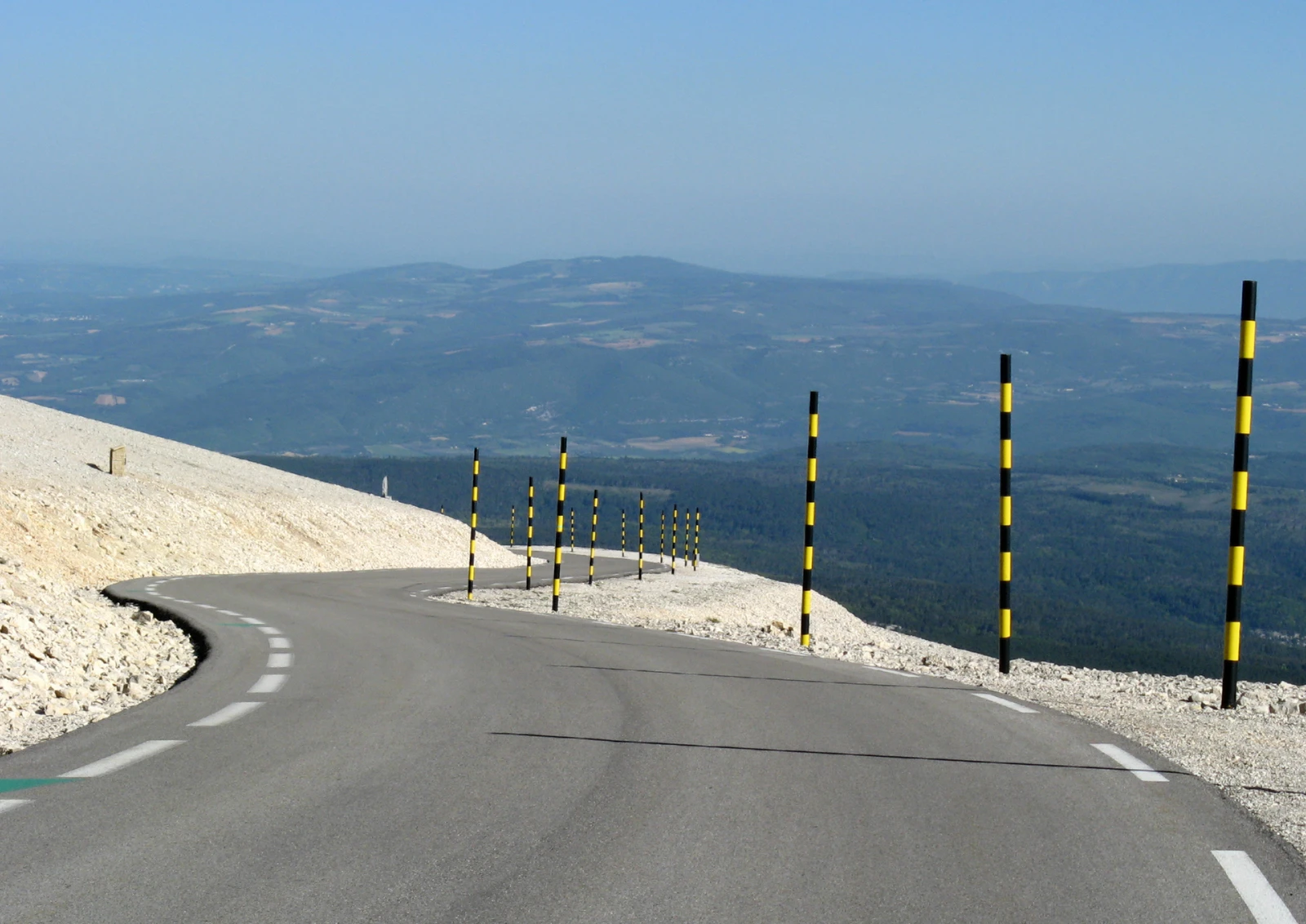
From dozens of kilometers away, it is instantly recognizable thanks to its striking white summit, almost lunar in appearance, which seems snow-covered even in the height of summer. In reality, the color comes from the limestone rock that covers the final kilometers of the climb.
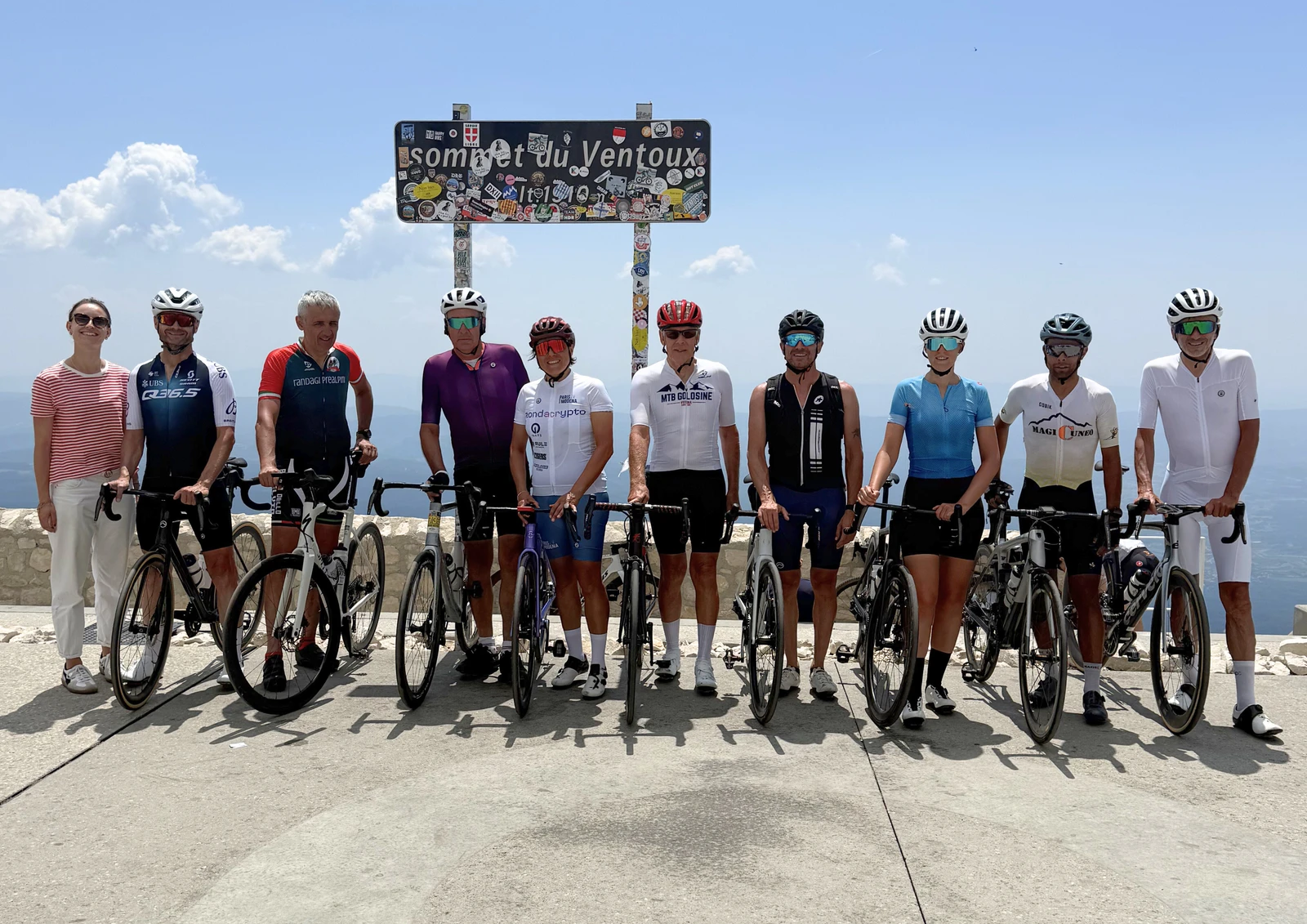
The Climb That Became a Legend
The classic ascent begins in the small village of Bédoin.
It stretches for 21.5 km, with more than 1,600 meters of elevation gain and an average gradient of over 7%. But the numbers tell only part of the story.
The opening kilometers allow riders to settle into a rhythm before entering the forest section, where the road steepens and seems to offer no respite. For roughly 10 kilometers, the gradient often remains between 8% and 10%, in a dense wooded environment that makes it difficult to gauge how far you still are from the summit.
As you reach Chalet Reynard, the scenery changes dramatically. The trees disappear, revealing the famous lunar landscape of Ventoux.
From here, a completely different climb begins.
The Final 6 Kilometers: Riding on the Moon
The last six kilometers are probably among the most famous in the cycling world.
All vegetation vanishes, replaced by white limestone rocks and a landscape that feels almost extraterrestrial. The iconic weather observatory at the summit always appears close, yet every bend reveals there is still more road to conquer.
On clear days, the views stretch across the Alps, the Rhône Valley, and even as far as the Mediterranean Sea.
It is a spectacle that rewards every drop of sweat.
The Real Opponent? The Wind
The name “Ventoux” itself comes from the French word associated with wind.
And for good reason.
The mountain is one of the windiest places in Europe, with gusts capable of reaching remarkable speeds.
Many cyclists say that the true challenge of Ventoux lies not so much in its gradient, but in the unpredictability of its weather.
You can leave Bédoin under a blazing 30°C sun and reach the summit facing icy winds and conditions that feel entirely different.
The Stories That Made Ventoux Immortal
Mont Ventoux earned its legendary status through the Tour de France.
It was here that champions such as Eddy Merckx, Marco Pantani, and many others wrote unforgettable chapters in cycling history.
Yet the most poignant story is that of Tom Simpson.
During the 1967 Tour de France, the British champion collapsed just a few kilometers from the summit. Today, a memorial along the climb has become a place of pilgrimage for thousands of cyclists, who leave water bottles, caps, and small mementos in tribute to his memory.
Passing this monument during the ascent is always a deeply moving experience, a reminder of the passion, sacrifice, and human stories that have made Ventoux one of cycling’s most iconic mountains.
Mont Ventoux Facts
- It is known as “Mont Chauve” (The Bald Mountain) because of the complete lack of vegetation in its upper section.
- Every year, thousands of amateur cyclists travel from around the world to take on the climb at least once.
- There are three main routes to the summit: Bédoin, Malaucène, and Sault. The most ambitious riders attempt all three ascents in a single day.
- On the clearest days, the view from the summit can stretch from the Alps all the way to the Mediterranean Sea.
- Mont Ventoux is widely regarded as one of the five most iconic climbs in Europe, alongside the Stelvio Pass, Alpe d'Huez, Col du Tourmalet, and Passo del Mortirolo.